

United Black Students (UBS) works to build community on campus by creating a supportive space for Black students while celebrating Black history and culture.
Founded last fall, UBS was created after students noticed an absence of a Black student organization on campus. Although a similar group once existed, it disbanded after its original advisor left.
“We realized we didn’t have one,” said President Layla Rice. “There’s been one previously, but once the advisor left, it never got passed down to someone new.”
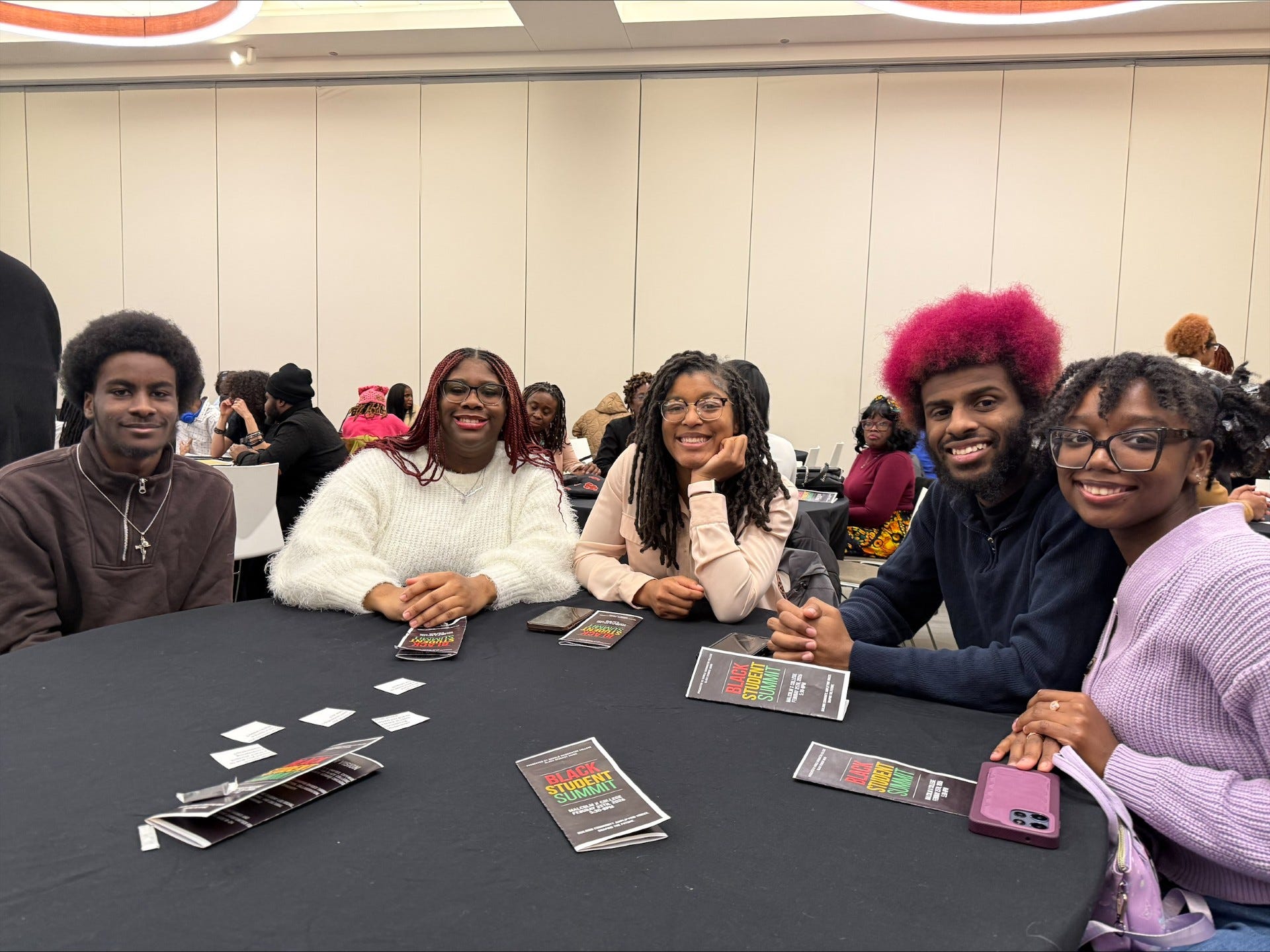
Members of UBS from left to right. Jayden Stovall, Brianna Dawson, Layla Rice, Xavier Kemp, Roterria Smith. Photo by Rev. Dr. John Huxtable
This semester, UBS plans to collaborate with as many other student organizations as possible to increase visibility and build connections across campus. In the future, members hope to host a Black student conference like the one they attended this past week.
Group members traveled to Chicago to attend the Black Student Summit hosted by Harold Washington College, where they met students from Black student unions across the city. Monmouth was the only rural school represented, inspiring UBS leaders to host their own conference to bring together both rural and city schools.
“The Black Student Summit gave us an opportunity to connect with Black student unions and other adjacent organizations, as well as share experiences and tips on how to better our organizations on our respective campuses,” said member Rotierra Smith,. “We got to hear from Jitu Brown, a member of the Chicago Board of Education, as well as one of Monmouth’s own alumni, Abrierre Minor.”
For many members, UBS is more than just a club– it provides a sense of belonging. The group was ultimately created to give Black students a space to share their experiences and connect with one another.
“I joined because I needed that space when I arrived at Monmouth, and incoming students deserve to have that space as well,” Smith said.
Although the organization is centered around Black students and culture, UBS is open to all students.
“We’re open to all students,” Rice said. “Some people automatically assume you have to be a person of color, but you don’t. We want more students that aren’t Black students, so that we can have different perspectives and backgrounds.”