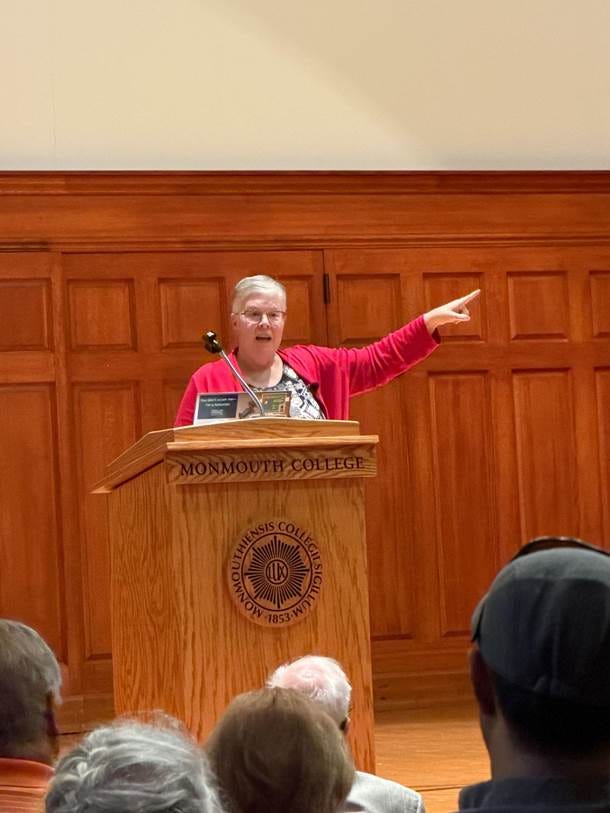
Professor Pamela Riney-Kehrberg spoke on the effects of the Farm Crisis in the 1980s on Monday for the tenth annual Wiswell-Robeson Lecture entitled “Remembering and Reckoning with the Farm Crisis of the 1980s.”
She explored topics consisting of economic, environmental and policy changes that were caused due to the farm crisis in the 1980s. As well as the mental strain the farm crisis had on farming families. Many farmers were losing their land or were in serious danger of losing their farms, which ultimately caused extreme stress and fear in many families.
“The losses didn’t just belong to adults. They belonged to entire families: men, women, and children,” Professor Riney-Kehrberg said.
Farms were being lost due to farmers regularly borrowing to maintain their business, farmers being young and in precarious condition, being young and ambitious, and due to being older farmers who had borrowed against the value of their land to bring children into their operations.
“I’ve talked to lots and lots of students whose families are farm families who don’t know much about this,” Professor Riney-Kehrberg said. A reason why it is so important to talk about the Farm Crisis, even forty years later, is due to how many young farmers are unaware of what has happened in the 1980s. Riney-Kehrberg said she wants to keep the awareness of what has happened in the past in discussion so young farmers can understand what has happened and learn from it.
Riney-Kehrberg has spent years researching these topics, having published five books and written 40 articles based around life on the farm, childhood and rural communities and humanity within the Midwest. She was a past president of the Agricultural History Society and past president of the Midwestern History Association.
Starting in 2016 through a gift from Jeanne Gitting Robeson a 1960 alum, The Wiswell-Robeson Lecture’s purpose is to annually feature a speaker from the agriculture community who explores issues, challenges and innovations in the industry.