

Political analyst and professor Robin Johnson led a conversation examining tariffs, political polarization, and the future of American economic leadership during last week’s Great Decisions foreign policy discussion series.
Johnson opened the presentation by describing competing public reactions to President Donald Trump’s former tariff strategy, using the acronyms “TACO,” meaning “Trump chickens out on everything,” and “TSAR,” meaning “Trump sometimes absolutely rocks,” to illustrate sharply divided perceptions of Trump’s negotiation style.
Discussion turned to real-world impacts when a local paper business owner described how tariffs and supply disruptions have strained small businesses. “It is hurting small businesses a great deal,” the attendee said. “I had seven items ordered and we have shortages. The tariffs are real, and they do affect other people.”
The business owner criticized inconsistency in trade policy, saying sudden tariff increases followed by reversals create uncertainty and fail to restore domestic manufacturing. “One day he’ll say I’m putting 40% on, and two weeks later he says he got a deal,” the attendee said. “It’s not bringing the jobs back.”
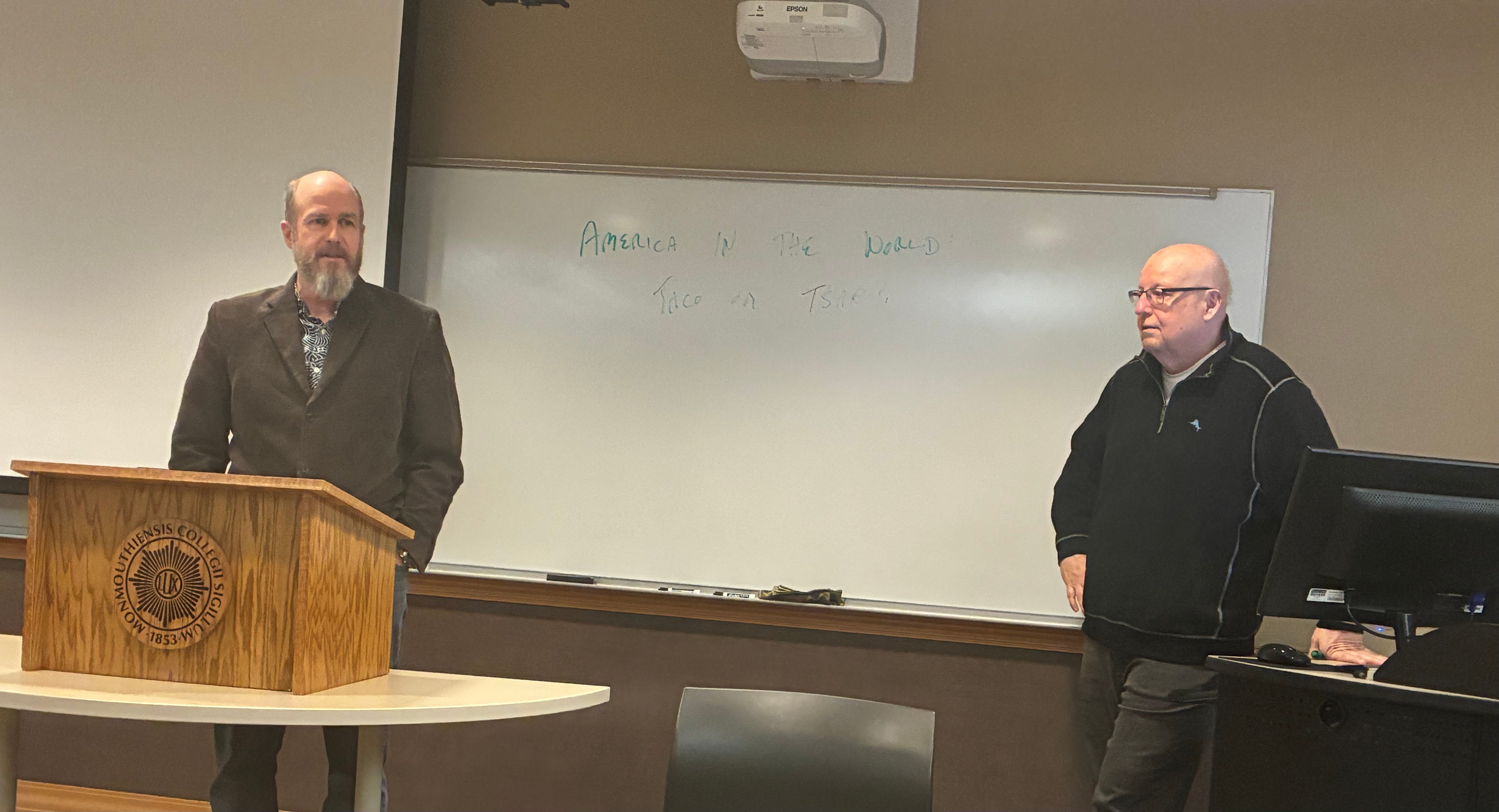
Professor Mike Nelson introduces Professor Robin Johnson. Photo by Seamus O’Sullivan
Johnson responded by distinguishing between the intent and execution of tariff policy. “I’ll defend the concept… I don’t defend the implementation,” Johnson said. He argued that efforts to address decades of manufacturing decline were overdue but unlikely to produce immediate results.
Johnson also emphasized the consumer trade-offs involved in reshoring production. “We’ve gotten used to this cheap stuff,” he said. “Is the American public willing to spend more for goods made here? I don’t know that we are.”
A question from Mike Nelson broadened the discussion to political and geopolitical consequences, including whether short-term gains from tariffs risk undermining the stability of the postwar international order.
Johnson noted that domestic political divisions complicate policy responses, pointing to a small but influential group of persuadable voters between strongly partisan camps. He also suggested Congress may eventually need to reclaim authority over trade and foreign policy decisions that have increasingly shifted toward executive power.
Audience members further questioned why lawmakers appear reluctant to challenge tariff policies that may harm their own constituents. Johnson argued that fear of primary challenges and pressure from partisan bases often discourages elected officials from publicly opposing trade measures.