

Professor Mike Nelson opened the first “Great Decisions” foreign policy discussion of the year last Wednesday with a clear warning: U.S. influence in Africa is slipping as China strengthens its economic and political ties across the continent. Tracing the relationship from the transatlantic slave trade to modern trade and aid policy, Nelson argued that American engagement has long centered on strategic and economic interests, particularly access to African minerals, and that recent policies may be accelerating a broader realignment.
“Africans were already consuming more Chinese products than American products, and I think we’re just going to see that continue to grow,” he said.
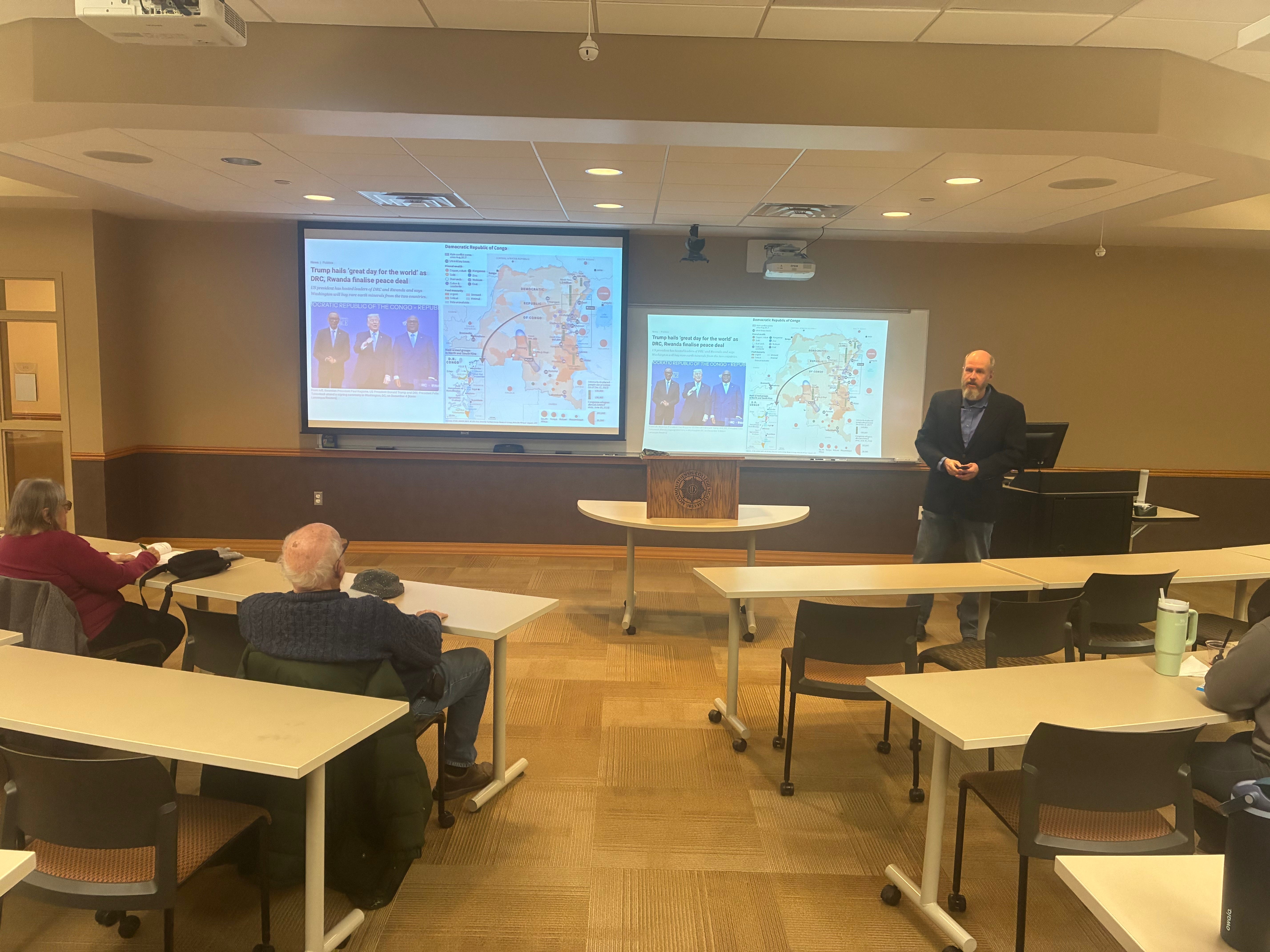
Professor Nelson giving his presentation. Photo by Seamus O’Sullivan
Nelson said China’s advantage lies partly in its own recent development. “One of China’s advantages is that it was more recently undeveloped, or lesser developed, and it can tell a story to these countries about having a model for developing quickly that is exciting and worth following. That ties countries to them,” he said. He pointed to consumer technology as a practical example. “The telephones that Huawei produces and tests in African markets on a large scale can handle the dust, the environment, the poor weather conditions, the high humidity. They’re producing products that end up being more desirable,” he said.
The discussion also revisited President George W. Bush’s President’s Emergency Plan for AIDS Relief, or PEPFAR, as a contrast to more recent approaches. Nelson described Bush’s philosophy of compassionate conservatism as “a version of conservative policies that was still interested in providing some kind of extra support, that you didn’t want to call welfare or social services, but for people in need in different places. That was my interpretation of it,” he said. “He tied it to values, Christian values for sure, and combined that with pre-market policy,” he said.
When asked whether PEPFAR could return to earlier funding levels, Nelson focused on the trust gap that may now exist. “I have no idea what will happen because by that point, a lot of countries will have had to figure out how they’re going to deal with any gaps. And they may not want to trust us. They probably shouldn’t,” he said. On whether China might step in to fill those gaps, he said, “Not yet that I know of. It could eventually.”
Students also asked about former President Donald Trump’s opposition to nation-building and whether recent rhetoric aligned with that position. “Venezuela is interesting because he made it sound like nation-building. Even Gaza, he made it sound like nation-building in a sense, like we were going to take over a small territory and make it work,” he said. At the same time, he distinguished between rhetoric and action. “So far with Venezuela and Gaza, he hasn’t taken those extra steps. We don’t have the kind of presence on the ground that we did with Afghanistan. There hasn’t been a true nation-building attempt in either place. It has more of the light rhetoric around it. I’d bet that’s as far as it will probably go,” he said.
The evening closed with questions about tariffs and trade. Nelson said strained trade relationships could create consequences for American manufacturers. “To the extent that trade policy is making us less desirable as a trade partner, and other countries don’t want to send us
their products because the tariffs are high, that means the inputs our producers rely on are costing more. The people using those inputs are going to be at a disadvantage,” he said. Referring to trade with China, he said, “I saw a statistic of something like a 77 percent drop in trade. That’s pretty significant.”