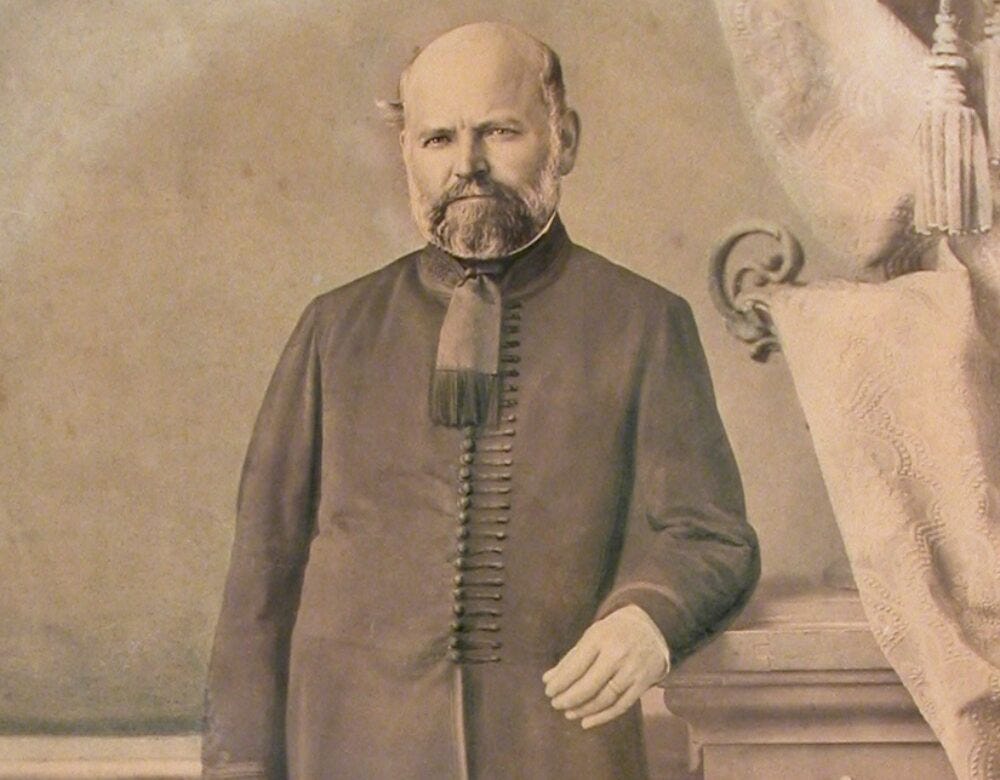
Ignaz Semmelweis was born in 1818 in Budapest. In 1837, he began studying law at the University of Vienna but soon switched to medicine with a specialization in obstetrics, earning his degree in 1844. He then joined the obstetric department at the Vienna General Hospital and eventually began to collaborate with Carl Con Rokitansky, a pathologist who often performed autopsies on women who died during childbirth. While working in two obstetric wards at Vienna General Hospital, Semmelweis noticed the physician-run ward’s mortality rate was three times higher than that of the midwives’ ward. He became fascinated with this knowledge. In the 1800s, many women died following childbirth due to childbed fever, also known as puerperal fever, which at the time was believed to be caused by miasma, or bad air, but considering that many of the pregnant women were from similar social backgrounds and were delivering in the same hospital, “bad air” was an unlikely cause.
In 1847, the death of Jakob Kolletschka, one of Semmelweis’s coworkers, who died after cutting his hand with a scalpel during an autopsy, changed everything. Following the accidental cutting of his hand, Kolletschka quickly fell ill with symptoms affecting his abdomen, lungs, and brain, all symptoms frequently seen with childbed fever. Semmelweis concluded that childbed fever was caused by contamination from the dead body. Semmelweis began experimenting with washing his hands with soap, water, and a nail brush after autopsies, and later including chlorinated lime, because it was able to eliminate the odor and, therefore, what he believed was the “poison.”
Semmelweis used his findings to implement a new policy in his ward requiring all doctors and medical students to disinfect hands with chlorinated lime before examining pregnant women. Following this change, the mortality rate in Semmelweis’ ward dropped from 18.27% to 1.27% by 1848. The new policy was not welcomed by all, though. Johann Klein, Semmelweis’ superior, stood firm in the belief that childbed fever was caused by bad air and could not see the point in handwashing; however, many physicians did support Semmelweis, sending letters all over Europe to share his findings. Unfortunately, the letters that were sent in the hopes of change were the start of an international debate that ultimately led to Semmelweis’ dismissal from the Vienna General Hospital in 1849.
Semmelweis, however, was not going to silence his fight over losing his job. Semmelweis began working unpaid at Szent Rókus Hospital, and in 1861 published Die Ätiologie, der Begriff und die Prophylaxis des Kindbettfiebers, which translates to The Etiology, Concept and Prophylaxis of Childbed Fever. Despite having the proof to back up his argument, many physicians continued to dismiss Semmelweis’ handwashing significance. Frustrated with the continued rejection, in 1862 Semmelweis wrote an open letter to the medical community stating, “It weighs on my conscience that thousands upon thousands of mothers and infants have perished—lives that could have been saved . . . The killing must end, and to bring it to an end, I shall stand guard. Whoever dares to promote dangerous doctrines about childbed fever will find in me a resolute opponent.” Semmelweis remained firm in his belief; however, the continued rejection and fight ultimately led to his admission to a mental institution in Oberdöbling, outside Vienna, where he died in 1865 due to a wound infection. It was only after his death that his findings were accepted throughout the medical establishment, following the introduction of the germ theory and advancements in antiseptic techniques.