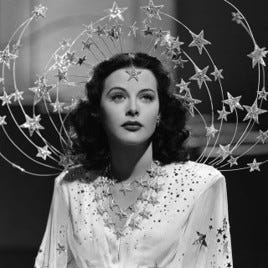
Born November 9th, 1914, in Vienna, Austria, Hedy Lamarr spent her early life on long walks with her father discussing the inner workings of machines like the printing press and automobiles, forming her fascination with machinery and innovation. By the age of 5, she would often be found disassembling and reassembling her own music box to understand how it worked.
At the same time, her mother was also fostering her love for the arts and the stage through ballet and piano lessons. At the age of 16, her beauty was recognized by director Max Reinhardt, and by 1930 she was cast in her first small film role as a young girl at a nightclub in a German film, Geld auf der Straβe (“Money on the Street”). At 19 years old, her lead role in the play Sissy gained the attention of an Austrian munitions dealer, Fritz Mandl, and later that year they married. However, her marriage to Mandl was short-lived; writing in her 1966 autobiography, Ecstasy and Me: My Life as a Woman, “I was like a doll. I was like a thing, some object of art which had to be guarded—and imprisoned—having no mind, no life of its own.” However, she did take away the knowledge of weapons systems that would aid in her brilliant inventions later in life.
In 1937, she was able to escape to London, where she met Louis B. Mayer, co-founder of MGM Studios, and entered the world of Hollywood, where her grace, beauty, and accent mesmerized her American audiences. She became known as the “Most Beautiful Woman in Film”. In Hollywood, she met Howard Hughes, a businessman and pilot, who relit her love of science and innovation with Hughes’ desire to create faster planes that could be sold to the US military. She bought books on fish and birds and analyzed the fin and wing structures of the fastest species to create a new design for plane wings. She also invented things like an upgraded spotlight and a tablet that dissolved in water to make a Coca-Cola-like soda, but her most significant innovation occurred during World War II.
In 1940 Lamarr met George Antheil, who shared her love of innovation, and helped form ideas to aid in the war efforts. The two created a new communications system with the intention of guiding torpedoes to their targets that used coordinated “frequency hopping” of the transmitter and receiver across radio waves, which prevented the interception of radio waves, reducing the risk of detection or jamming. Lamarr and Antheil sought and were awarded Patent No. 2,292,387, in August of 1942; however, the Navy rejected implementation of the new system. Still wanting to contribute to the war efforts, Lamarr turned to her celebrity status and began selling war bonds and is credited with selling $25 million in bonds.
Unfortunately, the patent on Lamarr’s system expired before she ever saw a penny. She continued to gain acknowledgement for her films and acting until 1958, but she had yet to receive any public acknowledgement for her innovations. It wasn’t until 1997 that Lamarr and Antheil received acknowledgement for their work with the Pioneer Award from the Electronic Frontier Foundation. That same year, Lamarr also became the first woman to receive the Invention Convention’s Bulbie Gnass Spirit of Achievement Award. She passed in 2000, but in 2014 she was honored with induction into the National Inventors Hall of Fame, and she has received the nickname “the mother of Wi-Fi”.