

Anthropologist, Global Studies scholar, and Professor Petra Kuppinger delivered a Great Decisions lecture focused on the war in Ukraine, placing the conflict within a long historical and geopolitical context. Her talk blended history, politics, and cultural insight to help students understand what has led up to the wat and why its consequences extend far beyond Eastern Europe.
Kuppinger began by tracing the region’s complex history, explaining that Ukraine has long existed at the crossroads of empires, cultures, and political systems. From centuries of imperial rule to the Soviet era, the country’s identity and sovereignty have been shaped by outside forces. This historical backdrop, she explained, is essential to understanding modern tensions with Russia.
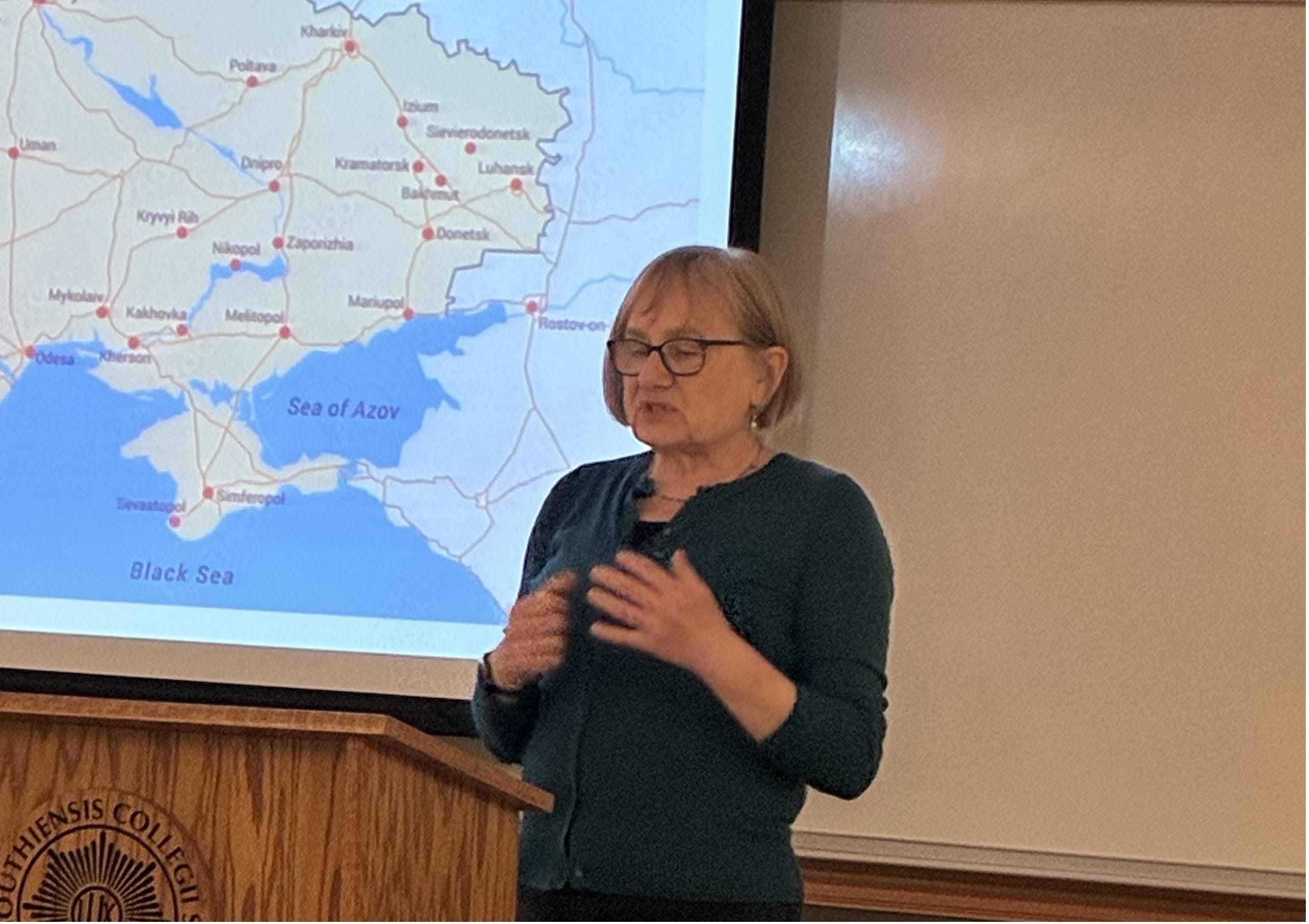
Kuppinger presenting her lecture. Photo by Seamus O’Sullivan
Kuppinger described how the dissolution of the Soviet Union created new borders, new political identities, and lingering disputes about power and influence. Over time, these unresolved tensions helped set the stage for the current conflict. She emphasized that narratives about the region are often simplified in public discourse, even though the reality is far more complex.
A central theme of the lecture was her clear position that the invasion is unjustified. “This war did not have to happen,” Kuppinger said, stressing that diplomatic and political alternatives existed. She argued that the war represents a violation of sovereignty and international norms, rather than an inevitable clash of civilizations.
The lecture highlighted the human dimension of the war. Beyond military strategy and political rhetoric, Kuppinger urged students to consider the lives disrupted by violence, displacement, and economic hardship. She noted that conflicts of this scale reshape societies for generations, affecting migration patterns, economic stability, and cultural memory.
Another key takeaway from the lecture was the global impact of the war. Kuppinger discussed how the conflict has influenced energy markets, food supply chains, and international alliances. She explained that the war is not only a regional crisis but a global one, with ripple effects felt across Europe, Africa, and beyond.
“The stakes are much larger than territory,” she said. “This is about international order and how conflicts are resolved in the modern world.”
Kuppinger concluded by encouraging students to stay informed and engaged with global affairs. She stressed the importance of critical thinking when consuming news and political narratives, reminding the audience that understanding history and context is essential for evaluating present-day events.