

Senior Brady Arrenius guided attendees of the latest Great Decisions lecture through the history and future of the United States’ complex relationship with Latin America that has shaped the Western Hemisphere for more than two centuries.
Understanding U.S.–Latin American relations, he argued, requires seeing both the historical roots of U.S. involvement and the present-day challenges facing the hemisphere. “Twenty-five percent of the population lives on less than $6.25 a day,” Arrenius said.
The presentation traced the relationship back to the early 19th century and the origins of the James Monroe-era Monroe Doctrine, which declared the Western Hemisphere off limits to European colonization and interference. Arrenius walked the audience through major turning points, including the Mexican–American War, the Spanish–American War, and the Roosevelt Corollary, which justified U.S. intervention in Latin America and led to projects like the Panama Canal.
Still, U.S. involvement remained significant during the Cold War, with military interventions and political influence shaping the region from the 1950s through the 1990s. Arrenius concluded the historical overview with the creation of the North American Free Trade Agreement, emphasizing how economic ties have become a defining feature of modern relations.
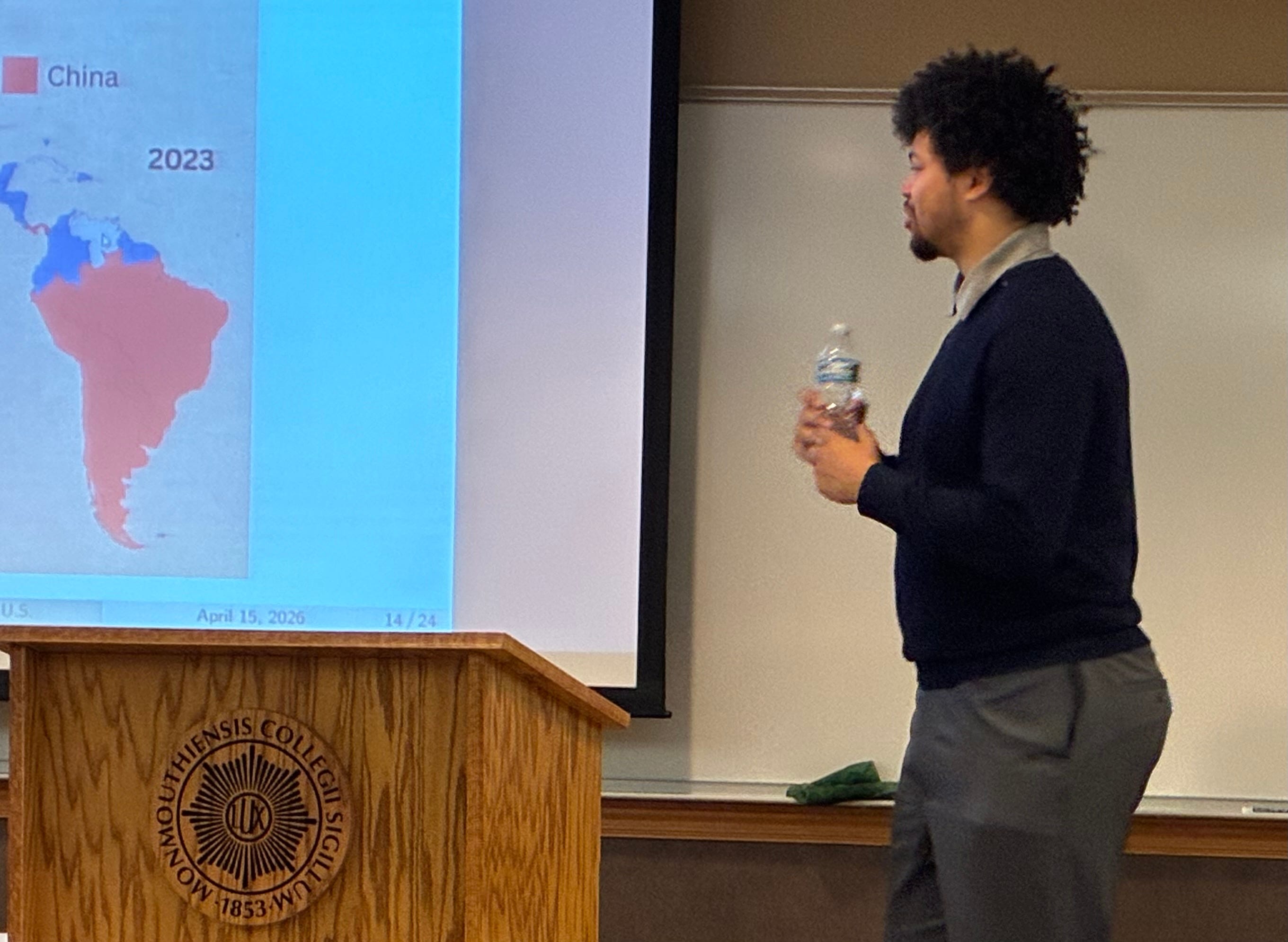
Arrenius presenting at the lecture. Photo by Seamus O’Sullivan
Turning to the present, Arrenius discussed the rapidly changing political landscape in Venezuela and the dramatic capture of Venezuelan leader Nicolás Maduro by the U.S. in early 2026. The unprecedented operation shocked the international community and has raised questions about democracy, sovereignty, and the future of the region.
Arrenius noted that while remnants of the previous regime remain influential, there are signs of cautious optimism. “Economists are now more free to express dissent towards the government. Civil liberties are being increased. Hard to say for sure, but I believe the next elections will be free and fair,” he said.
The conversation also touched on the volatility of U.S. relations with Cuba. Arrenius explained how policy has fluctuated depending on which party controls the White House, creating uncertainty in the region. He noted that Cuba has recently experienced massive blackouts after oil shipments from Venezuela were cut off, illustrating how interconnected Latin American economies remain.
Finally, Arrenius addressed the growing global competition shaping the hemisphere. China’s expanding presence in Latin America has become a major concern for U.S. policymakers. For example, China shifting its soybean imports to Argentina during the U.S.–China trade war shows how economic rivalries between major powers ripple across the region.
The presentation closed with a reminder that the story of U.S.–Latin American relations is far from finished. As Arrenius prepares to continue his academic career studying the region, students left the session with a deeper understanding of how history, economics, and geopolitics continue to shape the Americas today.
Arrenius recently studied abroad in Uruguay and plans to pursue a PhD in comparative politics and methods at the University of Maryland with a focus on Latin American politics.