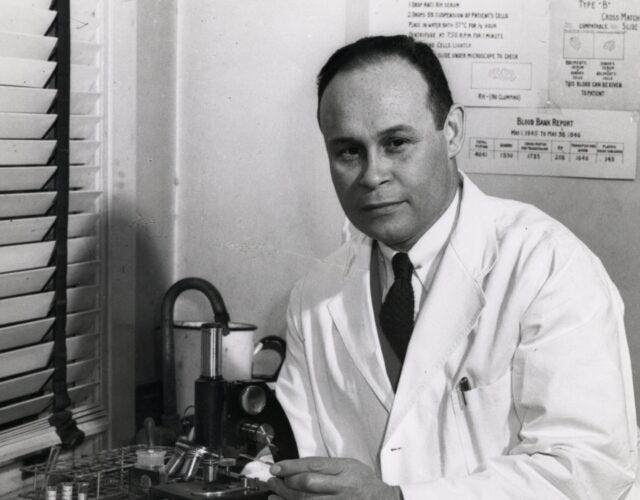
Charles Richard Drew was born on June 3rd, 1904, in Washington, D.C. In 1922, he began his bachelor’s degree at Amherst College in Massachusetts, as one of the only 13 black students. He completed his bachelor’s degree in 1926 with a heavy focus on biology and chemistry, largely due to the loss of his sister to tuberculosis while he was in high school. He then attended McGill University in Montreal, Canada, where he won the J. Francis Williams Prize in Medicine and the annual scholarship prize in neuroanatomy. He also worked on the McGill Medical Journal, before graduating with his medical and Master of Surgery degrees in 1933.
Drew then went on to his internship and residency at Royal Victoria Hospital and Montreal General Hospital, where his focus turned toward blood transfusions. He earned a Rockefeller fellowship in 1938 and started toward a doctorate at Columbia University, where he began collaborating with John Scudder and continued his research into blood preservation and fluid replacement.
In 1940, Drew published his doctoral thesis titled “Banked Blood: A Study in Blood Preservation,” during World War II, when Great Britain was in dire need of blood and plasma, leading to Drew and Scudder’s crucial work in launching the “Blood for Britain” program to transport plasma overseas. The delivery of plasma can be used with any blood type and helps to replace essential fluids and treat shock, meaning the 5,000 liters of plasma that were delivered to England were monumental in saving the lives of wounded soldiers.
With the success of the “Blood for Britain” Program, in 1941, Drew became the first Black surgeon to serve as examiner on the American Board of Surgery and the first director of the American Red Cross Blood Bank in New York. Despite the desperate need for blood during World War II, though, the armed forces prohibited black donors. Eventually, in January of 1942, the Red Cross began allowing black donors, but much to the opposition of Drew, the blood was segregated, supplies stored separately by race, and only allowed black blood to be received by a black person. In 1944, Drew wrote to the director of the federal Labor Standards Association saying, “It was a bad mistake for 3 reasons: (1) No official department of the Federal Government should willfully humiliate its citizens; (2) There is no scientific basis for the order; and (3) They need the blood.” The American Red Cross finally ended its blood segregation in 1950.
After his work with the National Blood Bank, Drew focused on training and mentoring surgical residents and medical students; he was appointed chief of staff at Freedmen’s Hospital in 1944, elected Fellow to the International College of Surgeons in 1946, and was a consultant to the Surgeon General in 1949. In the end, Drew was a professor and Chief of Surgery at Howard Medical School when he tragically passed after a severe car accident in 1950.