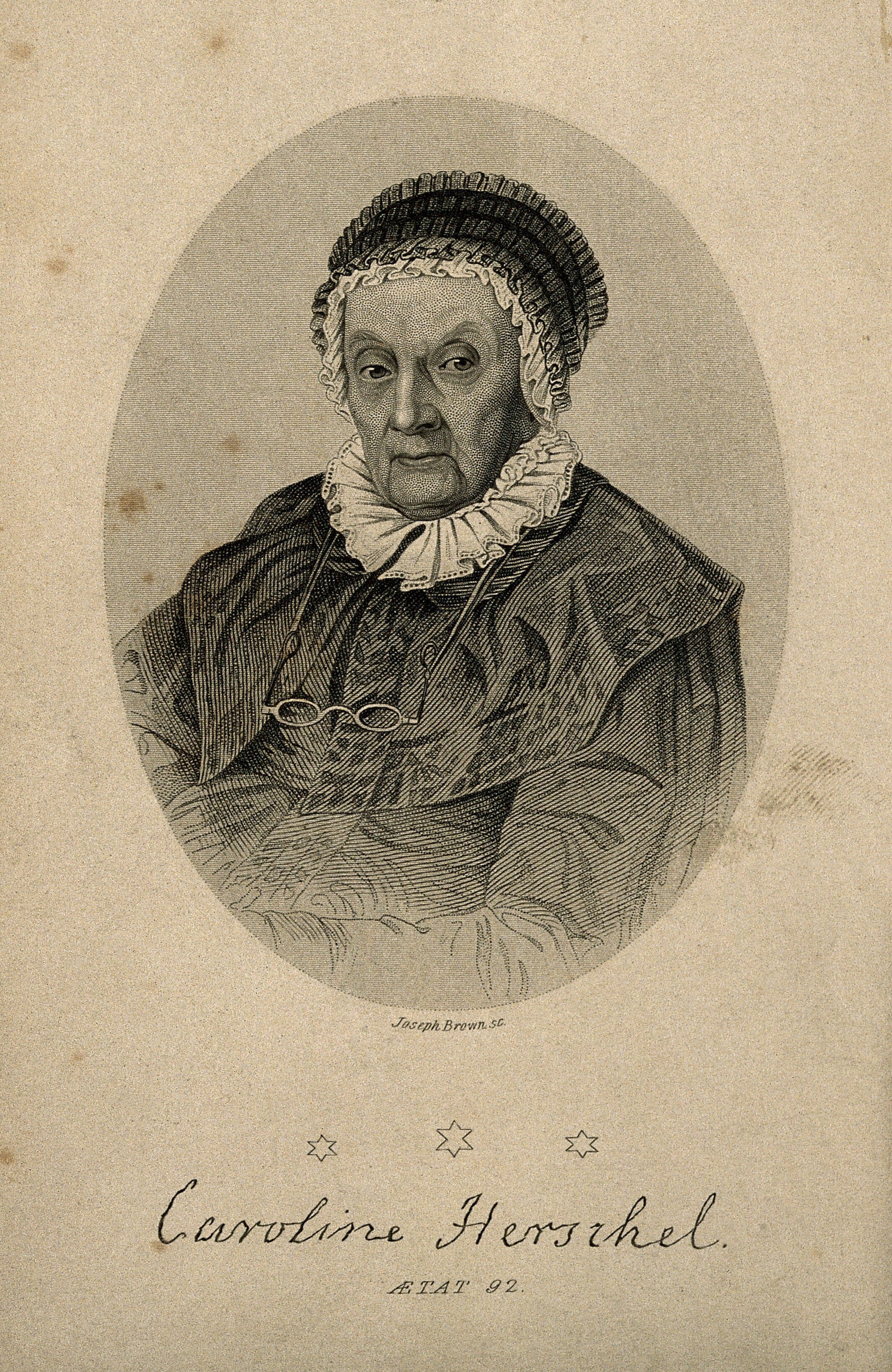
Caroline Herschel was born on March 16th, 1750, in Hanover, Germany. During her childhood, her father taught her music as well as how to read and write, which was unusual in the 18th century when women’s education focused on their expected domestic roles. In 1772, she followed her brother William to England, where he worked as a musician with the hope of becoming a singer alongside her brother. By 1778, she was singing as a premier soloist in her brother’s concerts, even performing in the Octagon Chapel, Bath, a prominent, high-end venue that numerous well-known high society figures frequented.
Eventually, William formed an interest in astronomy, often pulling Caroline away from music to help build telescopes that they would use to map the shape of the Milky Way galaxy. Caroline helped to record and document the observations, while William scanned the sky, calling out observations. In 1782, William was named the King’s Astronomer, and Caroline was formally recognized by the government for her role in assisting him, making her the first woman in Britain to earn an income in the sciences.
In her spare time, she made observations of her own using a small telescope to search for comets, and recorded her observations of nebulae. She discovered many new star clusters; notably, in 1983 she discovered “a beautiful cluster of pretty compressed stars”, now called NGC 2360 or “Caroline’s Cluster”. In 1786, she wrote the Royal Society, stating, “Last night, the 1st of August, about 10 o’clock, I found an object… I suspected it to be a comet,” becoming the first woman to discover a comet. She later published a list of 560 stars not listed in the British Catalogue of Fixed Stars, which was the most accurate star catalogue of the time, organizing the stars by their position in the sky rather than by the constellation they appear in, which had been the standard prior to her publication. Her catalogue was published in 1802 by the Royal Society and would later become the basis for the New General Catalogue of Nebulae and Clusters of Stars, introducing the use of NCG in Nebulae and star cluster naming.
In 1822, her brother passed, and she returned to Hanover, Germany, continuing her work in astronomy. The last observation entry she made was on January 31st,1824, with the observation of the Great Comet of 1823.
Caroline was one of the few female scientists in the late 18th to early 19th century who received acknowledgement for her work while she lived. In 1828, she was the first woman to receive the gold medal from the Royal Astronomical Society; the next woman would not receive this award until 1996, more than 150 years later. Caroline Herschel died January 9th,1848, at the age of 97. An asteroid, Asteroid 281 Lucretia, a Crater on the Moon, lunar crater C. Herschel, and a comet, 35P/Herschel-Rigollet, were all named in her honor. The inscription on her tomb that she wrote
reads: “The eyes of her who is glorified here below turned to the starry heavens.”