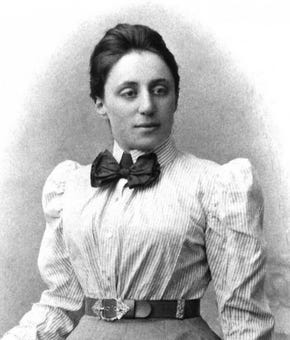
Amalie “Emmy” Noether was born on March 23rd, 1882, in Erlangen, Germany. She was the oldest of four children, but one of only two who survived childhood. Both her brother, Fritz, and her father, Max, were both mathematicians, however she wouldn’t find her love for mathematics until later in life. As a child, she studied French and English, and upon graduating from high school, she passed the test that allowed her to teach French and English at a women’s-only school.
At the age of 18, she decided to follow her brother and father and take mathematics classes at the University of Erlangen, where her brother was a student, and her father was a professor. Unfortunately, because she was a woman, the university refused to allow her to take classes as a student but eventually allowed her to attend the classes without receiving credit or grades for them. She sat in classes for 2 years before taking an exam that allowed her to become a doctoral student in mathematics, and after 5 years, she became the second woman to be granted a degree in the field of mathematics.
Following completing her degree, she wanted to find a job teaching, however the University of Erlangen refused to hire her because of their policy against female professors. Ultimately, Emmy decided to work with her father, helping to teach classes when he was sick, while also beginning to publish papers on her work. She worked for her father for 10 years, never receiving pay for her work teaching.
In 1915, Felix Klein and David Hilbert, who were working on defining Einstein’s theory of general relativity at the University of Göttingen, invited Emmy to join their efforts in the hopes that her knowledge would help advance their work. Emmy was hesitant to leave because there were no women on the faculty at the University of Göttingen, and many of the faculty did not want her there, but eventually she decided to join Klein and Hilbert. In 1918, her work proved two theorems that were groundbreaking for general relativity and elementary particle physics, one of which is still known as “Noether’s Theorem”. She was eventually given a job as a lecturer, becoming the first woman professor in Germany in 1922, teaching under her own name but not receiving pay for another three years.
Noether gained a very loyal student following, many of whom would become great mathematicians and credit Noether with teaching them to teach themselves. In the 1920’s, she did foundational work on abstract algebra, working in group theory, ring theory, group representations, and number theory; her conceptual approach to algebra also led to principles unifying algebra, geometry, linear algebra, topology, and logic. In 1932, she was asked to give a lecture for the International Mathematical Congress in Zurich and was awarded the Ackermann-Teubner Memorial Prize in mathematics that same year.
With the start of World War II and Hitler’s rise to power in 1933, Emmy moved to the United States, where she was offered a teaching position at Bryn Mawr College. She worked at Bryn Mawr College until her unexpected death from illness in 1935. Following her passing Albert Einstein himself wrote to The New York Times saying she was “the most significant creative mathematical genius thus far produced since the higher education of women began” and commended her work for its “enormous importance in the development of the present-day
younger generation of mathematicians.”